

Your agency reports the metric it can control. Not the one Google uses to rank you.
You are paying for Domain Rating. Google does not use it. A DR70 link from a page with zero traffic does not move your rankings — and nor do fake placements from digital PR campaigns.
Google's own code exposed the answer.
In 2024, Google’s internal Content Warehouse API was accidentally exposed. The production fields named the exact signals WLDM had already been scoring.
WLDM had been measuring page-level traffic and topical context since 2021 — information passed to us by a Google employee. The leak closed the argument.
Confirmed by the 2024 API leak
The 2024 Google Content Warehouse API leak (documented by Mike King at iPullRank and SparkToro) exposed real production ranking fields:
- siteFocusScore — how topically concentrated a domain is. A site where every page covers the same subject scores high; a site spanning unrelated topics scores low, and its links carry less authority regardless of DR.
- siteRadius — how far individual pages drift from the site’s topic centroid. One SEO page on a cooking site has high siteRadius — a weaker topical signal no matter how strong the domain looks.
- sourceType — Google’s quality tier for the linking page: HIGH, MEDIUM or LOW. A HIGH-tier source passes substantially more authority. Domain Rating does not capture this.
Do guest posts on link marketplaces meet this criteria?
Methodology
The Reasonable Surfer Patent
Google’s Reasonable Surfer patent (US 7,716,225 — filed 2004, updated 2010) assigns link weight by the probability a link is clicked. A link inside a contextually relevant paragraph carries more weight than a footer or sidebar link. Our formula models this: context signals carry 100% of the base score (65% paragraph + 35% page); the anchor only adjusts it by a small signed δ.
The patent formula
r(A) = α/N + (1−α) · ( w1·r(B1)/|B1| + … + wn·r(Bn)/|Bn| )
where w = click-probability weighting for each linking page. A relevant in-body link on a trafficked page produces a high w. A footer link on a zero-traffic domain produces a w near zero. Domain Rating assigns equal weight to both.
What the leak confirms for the Reasonable Surfer
In the 2024 Content Warehouse leak, the Reasonable Surfer maps most closely to GoogleApi.ContentWarehouse.V1.Model.AnchorsAnchor. Key fields:
- pagerankWeight — “Weight to be stored in linkmaps for pageranker.”
- sourceType — quality/importance of the source page (HIGH/MEDIUM/LOW). This is the leak’s closest proxy for page-level traffic: a HIGH-tier page is one Google treats as important and regularly crawls — which correlates directly with real traffic. A zero-traffic page will not reach HIGH regardless of its domain’s DR.
- weight — Google’s internal authority score for the anchor, on a 0 to 127 scale. Higher values indicate more PageRank-style authority transferred through the link
- fontsize, context, context2, fullLeftContext, fullRightContext, offset, linkTags, locality, bucket — features around the link/anchor corresponding to the
patent’s weighting by document and positional features.
Topic-Sensitive PageRank and Site Focus Score
WLDM scores links against two established ranking signals. The Reasonable Surfer handles page-level traffic weighting. Topic-Sensitive PageRank handles topical cluster relevance.
Google does not crawl the whole internet for every query. For Nike shoes, the crawler enters the Nike topic cluster, travels a defined distance within that cluster, and ignores 99.9% of the
web. A backlink from inside that cluster counts. A backlink from outside it barely registers. This is the math WLDM measures.The 2024 Google API leak confirmed that Google stores and uses multiple PageRank variants per document:
PerDocData.pagerank0
PerDocData.pagerank1
PerDocData.pagerank2
PerDocData.crawlPagerank
PerDocData.toolbarPagerank
PerDocData.homepagePagerankNsSix distinct PageRank scores stored per document. Topic variants (pagerank0/1/2) for bucketed authority weighting. A crawl priority score (crawlPagerank) that determines how
often Google revisits a page — which correlates with real traffic. A site-level homepage score (homepagePagerankNs). And the old public toolbar score (toolbarPagerank), still tracked internally long after Google stopped publishing it. This is not a single global number. It is a multi-dimensional authority model — and none of it maps to Domain Rating.The leak’s direct field names for this signal:
- siteFocusScore — how topically concentrated a domain is. A site where every page covers the same subject has a high score. A site covering unrelated topics has a low one.
- siteRadius — how far individual pages drift from the site’s topic centroid. Low radius means tight topical discipline.
These two fields define whether a linking site sits inside or outside the topical cluster Google is weighting for your target keyword.
Why cosine similarity matters for backlinks
Cosine similarity (CS) is a 0 to 1 score for how topically matched a linking page is to your target page. It is an authority multiplier. From the same domain, a link scoring CS 0.6 passes approximately three times the authority of a link scoring CS 0.2. The placement costs the same. The authority transfer is triple.
The score runs across five tiers:
- 0.60+ — linking page is specifically about the same topic
- 0.40 to 0.59 — clearly relevant, strong match
- 0.20 to 0.39 — broadly related
- 0.01 to 0.19 — weak connection
- 0.00 or below — no topical match; zero authority value
WLDM scores every candidate link before building it. Anything below CS 0.2 is not built. Most agencies do not measure this at all — they filter by DR and call it done.
The math, precisely
WLDM’s scoring model is built on the signals confirmed in the 2024 Google API leak. Each text x → a 384-d embedding v(x) (mean-pooled, L2-normalised, so ∥v∥=1). Cosine = dot
product:cos(a,b) = (a·b) / (∥a∥∥b∥) = a·b (since ∥v∥=1)
Let c = cos(context, target), r = cos(refPage, target), a = cos(anchor, target).
base = 0.65·c + 0.35·r
δ = −0.15 if a < 0.15 (mismatch → anchorMismatchDemotion)
δ = min(0.10, 0.20·a) if c ≥ 0.40 (relevant anchor + strong context →adds)δ = −0.10 if a > 0.45 and c < 0.30 (exact-match in weak context → over-optimised)
δ = 0 otherwise (or generic anchor)
score = clamp(base + δ, −1, +1)Why context gates the anchor: a keyword-rich anchor like “buy gold online” always scores high a against a “buy gold” page — that overlap is circular, not evidence of a good link. The discriminator is whether the surrounding paragraph (c) supports it. Strong c → the match is a natural descriptive link (small bonus). Weak c → the same match is an over optimisation signal (penalty). The asymmetry (max penalty 0.15 > max bonus 0.10) reflects that Google’ link system is risk-averse: a bad anchor hurts more than a good one helps.
Harmonic Centrality
Stop optimising for fame. Optimise for network position.
Frankfurt airport moves more passengers than Paris even though Paris is better known. Domain Rating is Paris. Harmonic Centrality is Frankfurt.
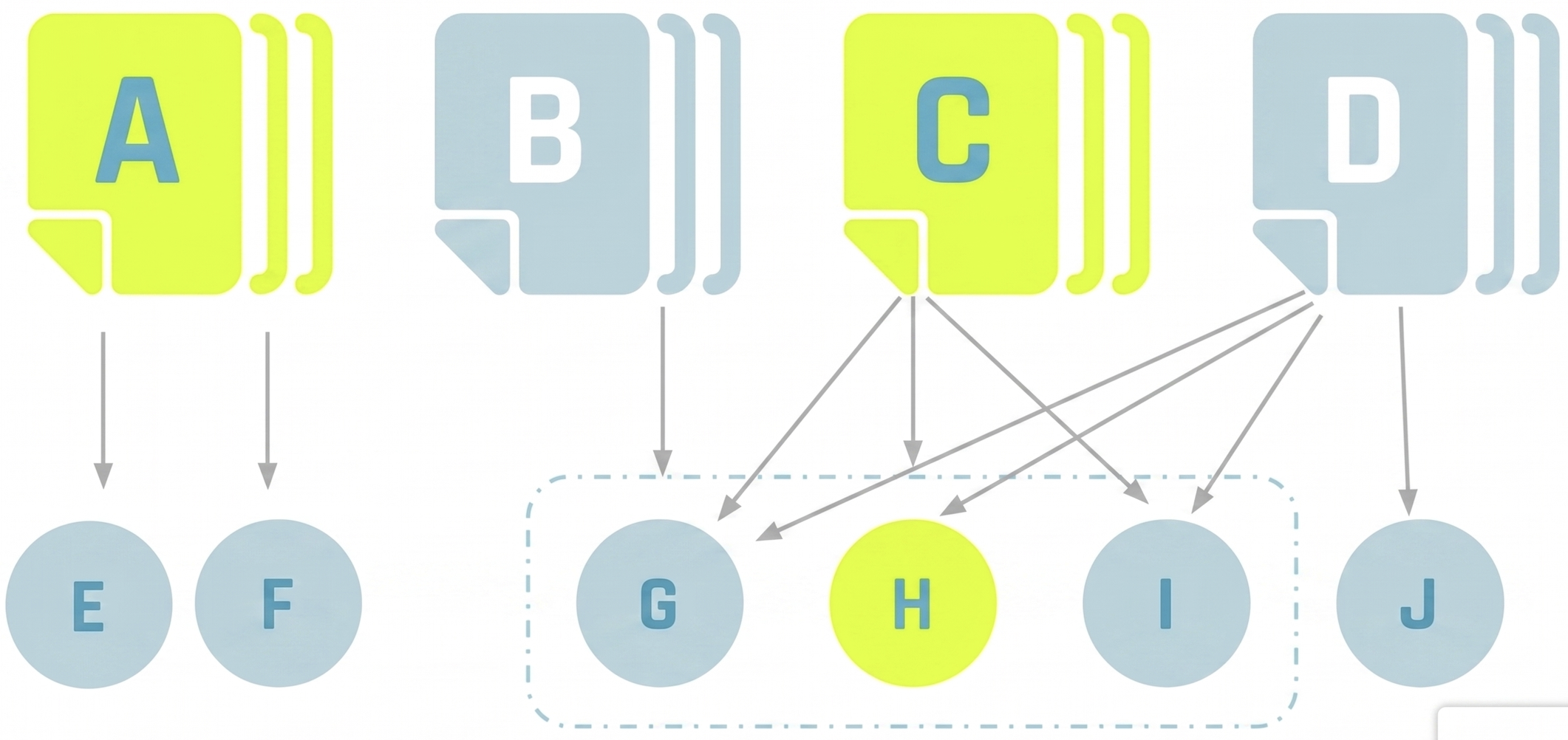
HC measures where a page sits in the authority network — not how well-known its domain is. WLDM scores each target page by CS-weighted in-degree Harmonic Centrality: the sum of all incoming, relevance-weighted edges on a directed link graph. Direct links contribute most. Each extra hop roughly halves the contribution. Only links with a positive CS score count — irrelevant links are excluded from the graph entirely.
The formula:
HC(u) = Σ 1/d(v,u)
where d(v,u) is the shortest path from linking page v to target page u, weighted by cosine similarity. A highly relevant link one hop away contributes far more than a dozen loosely related links two hops out.
The multi-target publisher advantage
A domain that places relevant links across several of your target pages accumulates HC multiplicatively — not additively. One publisher with six topically matched placements generates more total HC than twenty single-link domains at similar DR. This is what WLDM’s database is built to find.
Example from the Stake.com engagement: filmthreat.com delivered 2.44 total HC from 6 placements at an average CS of 0.56. No single high-DR domain with one link came close.
Head to head: WLDM vs the previous provider (Stake.com)
On the same account, same pages, measured against the same keywords:
Metric WLDM Previous provider Links analysed 603 30 Average target-page HC 1.59 0.37 Difference +330% (4.3×) — Zero or negative CS links 18.6% 30.0% The previous provider ran a brand and PR programme: F1 sponsorship coverage, cricket news, lifestyle press. 63% of their links sat in the zero, negative, or low relevance tiers. Brand impressions. Zero authority transferred to the commercial pages that needed to rank.
WLDM took Stake from outside the top 30 to number one for “online casino” — KD 95, 85,000 monthly searches — in ten months.
How do we do it?
Two metrics: page-level traffic and links from pages already ranking for your keywords or related keywords.
A three-part engine: data science first, human relationships second.
Most link building is a list someone bought. Ours starts inside our own data and ends with a real person on the other side of an email. We don’t sell open-ended retainers. We scope a 3-month project to a defined outcome and hit it.
Measuring both at scale requires a system most agencies don’t have.
Database extraction
Our link building database process started over four years ago. We’ve had a data science team for four years now. We spent hundreds of thousands of dollars on database improvement and years refining and developing our process. It currently involves over 600,000 domains x 1,000 passes for each domain that are all vectorised and customised for our link extraction method.
Quality assurance
We run the client’s topic through WLDM’s proprietary link database, the largest of its kind for any agency we know, and our machine-learning classifiers, which score and qualify backlink targets at 99%+ accuracy. Instead of filtering by raw Domain Rating, the system maps the client’s entity and topic graph and surfaces the domains and pages that are contextually closest, ranked by semantic proximity and harmonic centrality.
This is the data-science half of the engine. It sifts thousands of candidate sources in minutes and hands outreach a pre-qualified target list, to get links that are ranking for the keywords you want to rank for. It would take a human 100,000 hours plus to do this manually for each keyword.
Manual outreach
Qualified targets go to a human team. Every pitch is written for the specific editor and the specific page: real relationships, real editorial placements, on sites that are ranking for the keyword you want to rank for.
We are the only link building agency in the world that delivers links that are ranking for the keywords you want to rank for.
And we do this at scale with 6 figure retainers.
Don't believe us?
Look at the amount of referring domains. Spammy agencies do fake tiered link building. We just get the real stuff.
This is pure unfiltered no BS. And unlike any links you have purchased before.
Your site has a big ego.
A Morgan Stanley-level Domain Rating does not mean your product pages are ranking. Large brands watch their commercial pages get outranked by smaller competitors every day. Puffed on the outside. Weak on the inside.
The problem is not how much authority your domain has. It is where that authority lands. Domain-level metrics leave your product pages competing without the relevancy signal they need.
The relevancy layer is missing. WLDM links build it.
Every link WLDM builds goes to a specific commercial page, from a page already ranking for a related keyword. Not brand mentions. Not editorial features with no topical connection. Targeted relevancy, page by page, to the pages that drive revenue.
We will score your existing backlinks against the signals Google actually uses.
Most agencies have never done this to their own work. You will see why.
We audit your current backlinks, score each one for page-level traffic and topical match, identify which ones are contributing to rankings and which are not, and map the gaps your competitors are already filling.
You leave with a clear picture of what your investment has actually returned and a 90-day plan for what comes next.
Most link building is a list someone bought. Ours starts inside our own data and ends with a real person on the other side of an email. We don’t sell open-ended retainers. We scope a 3-month project to a defined outcome and hit it.
What the audit delivers — five outputs
1. ML quality classification of your existing link profile Every domain currently linking to you is run through WLDM’s ML classifier — 5-model ensemble, 99%+ accuracy, trained on 18,000 manually-curated domains. Each linking domain comes back as quality tier or link-farm flagged.
2. Cosine Similarity scoring against your target pages Every linking URL is scored using the three-signal model (65% paragraph context, 35% page body, anchor δ). Each link returns a CS score and tier — Strong, Moderate, Weak, or Irrelevant/Risk. Links below the build floor are identified as candidates for disavowal or deprioritisation.
3. Page-level traffic verification Every linking page is independently verified for real traffic. Distinguishes links from trafficked pages — which carry Reasonable Surfer weight — from links on zero-traffic pages that contribute almost nothing regardless of DR.
4. Competitor Harmonic Centrality gap analysis WLDM builds the HC profile for your top three competitors’ commercial target pages and maps it against yours. Output: which publishers carry the most HC weight in your category, which are linking to competitors but not to you, and which of your target pages have the largest centrality deficit.
5. 90-day authority roadmap Priority-ordered build plan: publishers ranked by expected HC contribution × topical match × page traffic, target pages prioritised by commercial value and centrality gap, and a projected authority accumulation curve based on engagement arc data from our case studies.
The Cosine Scorer — run it yourself
The same scoring model WLDM uses in every audit is publicly available as a free browser tool. Input a prospective linking URL and your target keyword. It returns a live CS score, tier breakdown, paragraph context analysis, and anchor match. Available at cs.wldm.io.
+ Free 1-hour strategy call with Brie
Every audit includes a one-hour call with Brie Moreau directly. Not a sales rep. Not an account manager. Brie built the methodology and runs the science team. He will walk through what the audit found, what it means for your rankings, and what the right next move looks like for your specific situation. Most agencies charge for this kind of access. It is included.
